 ✦ Choose your airplant design 0
✦ Choose your airplant design 0
✦ Choose your airplant design 017 September 2026
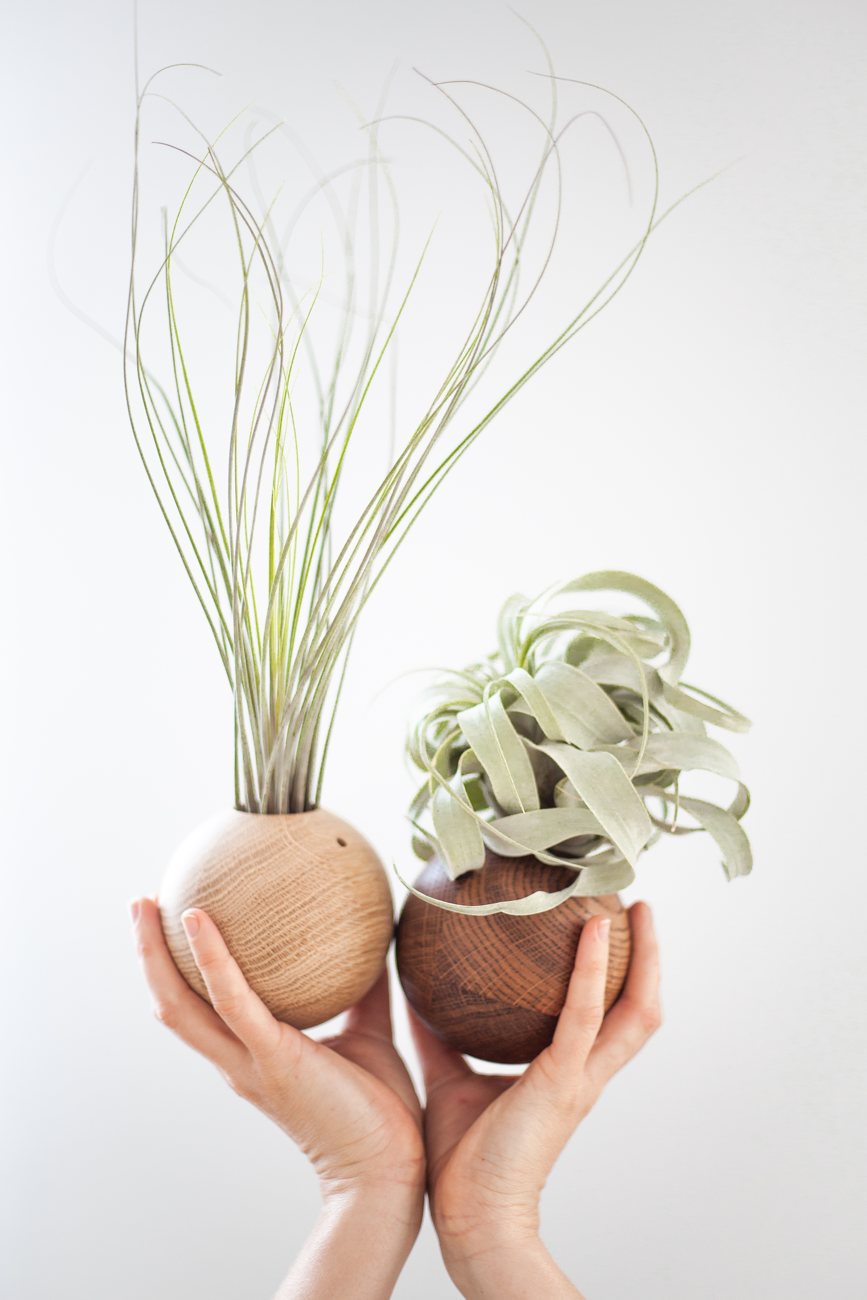
Air plants (Tillandsia) grow without soil, taking in water and light through their leaves, which is why they live happily on a shelf, a wall, or hung in the air. We include a living one with every holder. This is a short guide to the five we grow most, so you can choose the character that suits your space.
Small and easy, the one to start with. Bright green for most of the year, it blushes pink and red as it comes into bloom, then sends up a violet flower. Forgiving of the odd missed misting. Looks its best in the oak cube or a tropical nut.
The sculptural one: a wide silver-grey rosette of curling leaves that grows slowly and asks for very little water, the queen of air plants. Give it good light and let it dry fully between drinks. Sits beautifully cradled in a hanging sphere or a hemisphere.
Lush and green, and the showman: as it flowers, the whole plant turns deep crimson. Happy with a little more humidity than the others. Suits a hanging sphere or a cylinder.
Named for Medusa: a bulbous base and thick, silvery leaves that twist like snakes. Striking, sturdy, and hard to kill. Made for a hanging sphere or a wall cube.
Tall and architectural, a fountain of fine upright quills with rust-red tips. It adds height where the others spread wide. Best shown in a hanging cylinder or a sphere.
We also grow Harrisii and Spanish Moss, both in the collection if you would like to see them.
All five want the same simple base: bright, indirect light, fresh moving air, and regular misting. Mist two to three times a week, more in warm months or when the heating is drying the air. Spanish Moss drinks the most and can want four to five times a week.
Soaking is optional, and worth a word of caution. A long soak only suits a warm, dry spot where the plant can dry quickly afterwards. In a cool or humid room, or through the colder months, the water lingers and can rot the plant, so misting is the safer choice. If you do soak, keep it for the thirstier types (Spanish Moss above all, and if needed Brachycaulos and Caput-Medusa): lift the plant out, shake the excess water off by hand, then let it dry fully somewhere warm before it returns to its holder. Xerographica and Juncea can take a soak too, but only somewhere genuinely warm and dry.
Whatever you do, mist away from the wood, to protect the oak. The full routine is in our air plant care guide.
Ready to choose? Browse the collection and pick a holder with your plant. Already have a Tillandsia? Our oak holder (holder only) ships worldwide.
Join our mailing list to stay up to date with upcoming sales — and receive a 15% welcome discount on your first purchase.
WELCOME15
Use it at checkout under “Add promotion code”.